
Source:
Efficient Locomotion at Insect Scale: Researchers Develop Jumping Microrobot
MIT researchers developed a tiny spring-powered robot combining hopping with flapping wings. In the reported comparison it consumed less energy than its flying counterpart.
Source:
Efficient Locomotion at Insect Scale: Researchers Develop Jumping Microrobot
MIT researchers developed a tiny spring-powered robot combining hopping with flapping wings. In the reported comparison it consumed less energy than its flying counterpart.
Original publication date: · Archive story
First published on GUTTARIA:
Efficient Locomotion at Insect Scale: Researchers Develop Jumping Microrobot
MIT researchers developed a tiny spring-powered robot combining hopping with flapping wings. In the reported comparison it consumed less energy than its flying counterpart.
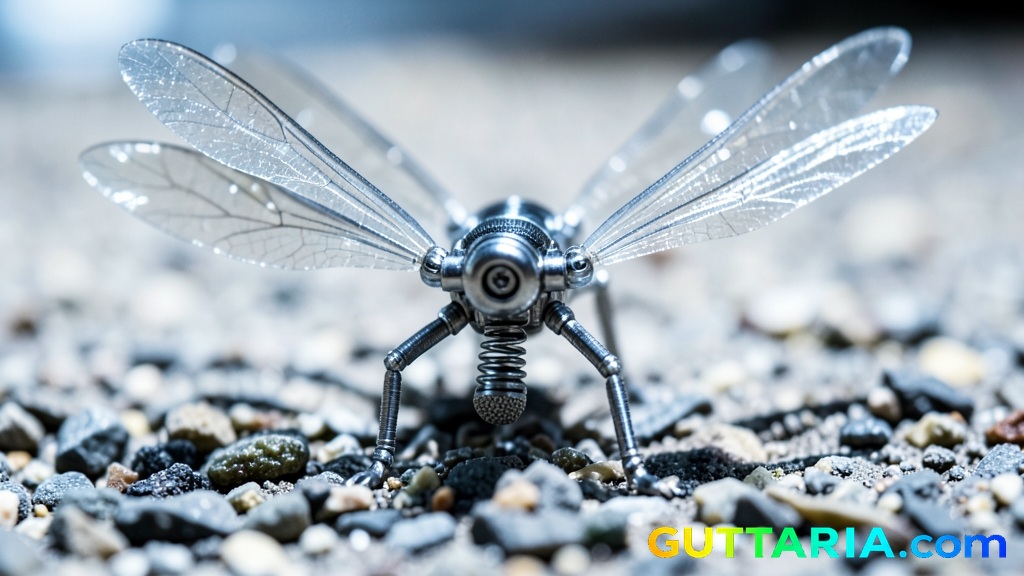
Editorial illustration, not a photograph of the actual device or a scientific result.
In robotics, movement in rugged terrain poses a major challenge for extremely small devices. While crawling microrobots often fail at obstacles, flying models consume too much energy to navigate through debris or over obstacles. To bridge this gap, scientists at MIT have developed a new jumping robot that combines the advantages of both worlds.
The research findings, published in 'Science Advances', demonstrate a hybrid approach: the robot utilizes the kinetic energy from jumps to overcome obstacles and small wing flaps for stabilization. This enables a movement that requires significantly less energy than pure flight.
A Research Prototype at Insect Scale
MIT researchers, including Yi-Hsuan (Nemo) Hsiao, have introduced a robot that is smaller than a human thumb and weighs less than a paperclip. The development aims to improve the mobility of insect-scale robots in complex environments, such as collapsed buildings following earthquakes.
Technical Details: Spring Force and Artificial Muscles
The propulsion system is based on an elastic leg made of a compression spring that pushes the robot off the ground. To control the flight phase and ensure orientation, the device features four wing-flapping modules. These are driven by soft actuators that function as artificial muscles and are robust enough for repeated landings. A rapid control mechanism calculates the necessary orientation for the next impact during the ballistic flight phase.
Practical Significance: Efficiency and Payload
The robot can jump approximately 20 centimeters high, which corresponds to four times its own height. A decisive advantage is the energy efficiency: the robot consumes around 60 percent less energy than a comparable flying robot. Due to its low self-weight and efficient mechanics, the system could theoretically carry ten times the payload of a purely flying robot of the same size, enabling the use of sensors and circuits.
Acknowledged Limitations: Current State of Research
Despite the impressive agility, technical hurdles remain. Currently, the robot is not yet autonomous, as it is connected to a power source via a power cable. Furthermore, the spring used is not ideal; it causes energy losses during ground contact, which must be actively compensated for by the wing-flapping modules.
Future Outlook: From the Lab to Deployment
The researchers have already demonstrated that the robot can navigate on a wide variety of surfaces such as ice, wet glass, grass, or uneven earth. Hsiao identifies carrying a battery and a sensor onboard as the next step toward independent power. Search and rescue operations or artificial pollination are possible long-term applications, not demonstrated deployments.