
Story and development
GUTTARIA Core — From idea to a working digital product
How the idea emerged for a system that connects people, artificial intelligence and real development tools in one understandable workflow.
Updated 3 November 2026
Where the idea began
GUTTARIA Core started with a simple thought: creating a software product should not be limited to people who have spent years working with code, terminals, build systems and complex technical infrastructure.
Between a good idea and a real application there is usually a large technical layer: architecture, source code, builds, tests, dependencies, errors, permissions and many different tools.
While developing GUTTARIA applications, it became clear that modern AI can already help write code, analyse errors and suggest solutions. But a conversation with AI is not enough. Code still has to be created, stored, built, tested and turned into a real product.
That led to GUTTARIA Core — a system intended to connect people, artificial intelligence and real development environments.

The core principle
Core should not simply generate code. Its role is broader: support development from the first idea to a verified result.
The user describes what they want to create in ordinary language. Core helps turn that idea into product structure, a development plan and concrete technical tasks.
Important decisions remain with the human. AI assists and performs permitted actions, while the user keeps control of the product and its direction.
GUTTARIA Core
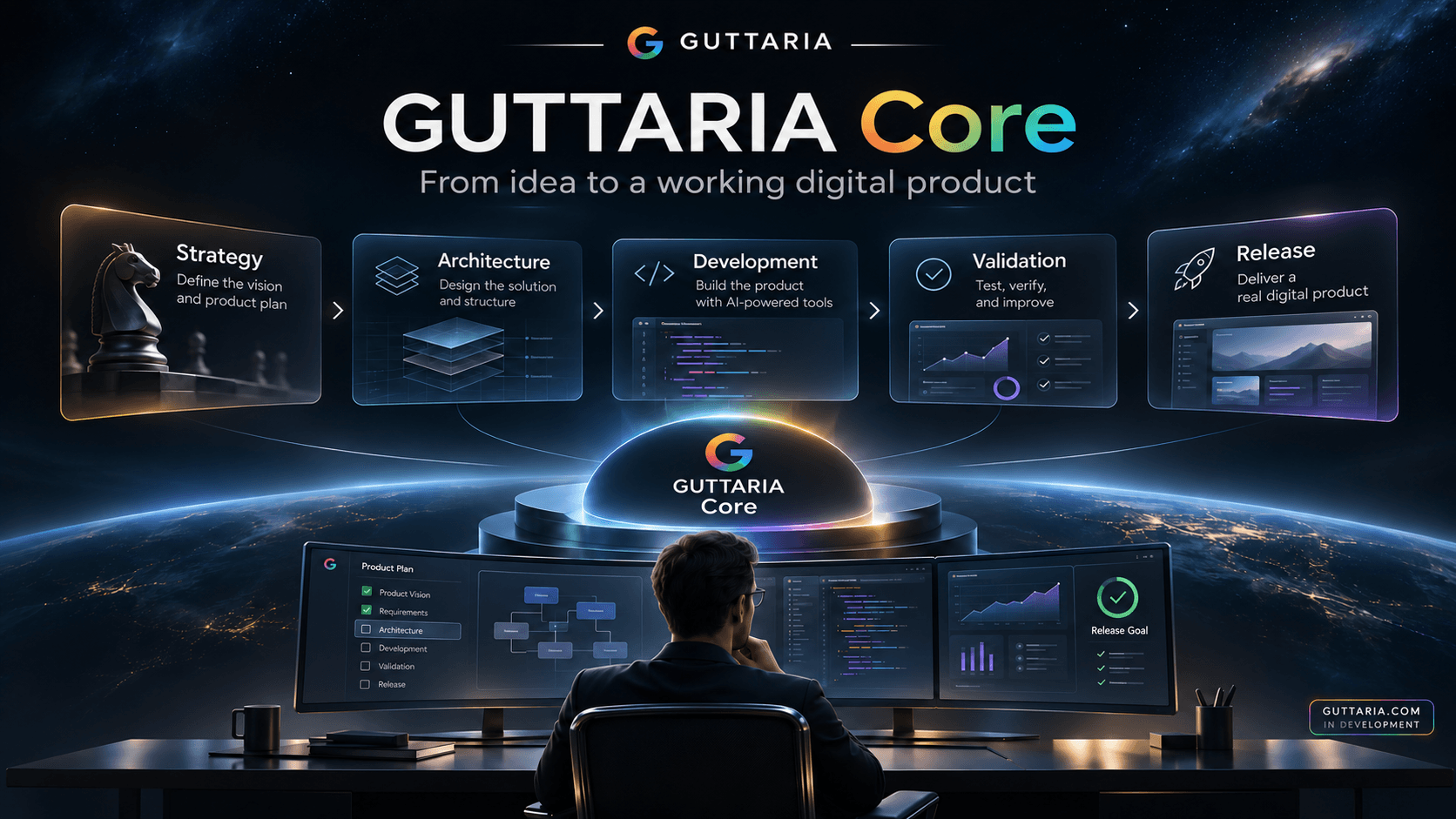
From idea to product
Idea and structure
First, the goal, audience and essential functions are defined. Separate ideas become a clear product structure.
Architecture
Next comes the technical foundation: application components, data, interface, local storage, external services and the connections between them.
Development
Core connects AI work to the real project. Files are created and changed, features are added and errors are fixed with awareness of the project as a whole.
Build and testing
Working code is not yet a working product. The application must be built with real tools, tests must actually run, and failures must return to the development process.
Verified result
Core should understand build status, test results, errors, version state and changes. Important milestones should be proven rather than merely declared successful.
Long-term memory and continuous project understanding
Complex development requires more than remembering the last few messages. Core should retain important decisions, corrections, project rules and previous results.
This prevents the project from starting again from zero in every conversation and turns Core into a persistent working environment.
Human control
Human control remains one of the central principles of GUTTARIA Core.
Important or risky actions should not happen silently. If a new permission, protected-file change or new binary execution is needed, the system should stop and ask for approval.
Automation should support people, not remove their control.

Where development stands today
Core has already passed through many development stages: long-term memory, knowledge persistence across restarts, secure local processes, real builds, tests and permission control.
One of the most difficult current areas is reliable Build/Test automation and obtaining verifiable results from real development environments.
Many steps are tested extensively. That takes longer, but it is necessary for a system that may eventually be trusted with real projects.
Where GUTTARIA Core is going
The final goal is an environment that covers the entire path: idea → structure → development → testing → working product.
AI should become part of the complete work system rather than a separate chatbot: remembering the project, understanding its state, assisting decisions, carrying out technical work and explaining problems clearly.
The human keeps the goal and control over the result.
Development journal
GUTTARIA Core development news
This section will document major development stages, technical achievements, problems and solutions.
3 November 2026
Core continues moving from experiments toward a real working system
Current work focuses on reliable builds and tests, long-term memory, secure process control and the ability to prove results through real checks. New entries will be added as development progresses.